Showing posts with label Genealogy. Show all posts

Thursday, February 13, 2014

Roots Tech 2014 - Part 1: New Immigrants vs. Old Immigrants

Last week I attended Roots Tech 2014 in Salt Lake City, Utah. Roots Tech is a relatively new annual genealogy technology conference that is hosted by the Mormon Church's Family Search with major sponsorship from Ancestry.com and Findmypast. Last year's boasted "Over 6,700 registered attendees from 49 U.S. states, six Canadian provinces, and 23 additional countries" along with over 120 exhibitors and vendors and more than 100 classes, labs or presentations.

As a young tech savvy student with almost ten years of genealogical research experience; I was more than happy to save my grad student travel funds to spend on this relatively expensive conference. In the end this turned out to be an exciting, eye-opening and frustrating experience. It was certainly worth the money and the time in my current situation but I can now definitely understand why some people were turned off by the event. But, for the sake of organization and flow, I will get to that later.


I landed in the gorgeous city of Salt Lake last Tuesday February 4. It was rather late at night thanks to a long day of flying so I was happy to check into the Airport Inn Hotel. That place was shockingly nice for the price. Plus I received a rather large free breakfast each morning. Hats off to the AIH!

My first day of the conference was the Wednesday Technology Summit. It started off a bit rough for me since even though I had the pleasure of meeting three Roots Tech attendees on the morning train, our lovely conversation about genealogy was momentarily derailed (at least for me anyway) by some ugly comments about modern immigrants. I was still exhausted from the trip/grad school/time change so when the middle aged woman from California went from proudly talking about her Polish immigrant ancestors to the "just any ol body they let in these days,  you know and they don't have to prove anything any more. They just let everybody become a citizen...", well I found myself in a bit of a quandary. I did not know much about the three people I was sharing the train with other than that one was a casual genealogy fan and the other two worked for genealogy companies. As a poor grad student in her final semester, who has a constant eye out for job opportunities, and knows how to code-switch, I knew I had three reaction options:

A) Have a, as the great Dave Chapelle once put it, "when keeping it real goes wrong," moment and completely flip out on the woman for her ignorance, short sightedness and lack of understanding of the history of immigration in this country and how incredibly difficult it continues to be for many wonderful, hard working, tax-paying immigrants to gain their citizenship.

B) Spend the entire rest of the train ride discussing America's many waves of anti-immigrant hysteria that have stretched back to, well, before there was an America. I mean have you seen Gangs of New York? Ok thats a movie, bad example. Have you heard of the Alien and Sedition Acts of 1798? Those were signed to keep the French and Irish immigrant populations disenfranchised in America. Ok how about the Chinese Exclusion Act of 1882 or the Gentleman's Agreement of 1907 which very ungentlemanly fought to keep the Japanese from immigrating to America? Nativists and their sentiments have been demonizing new, unassimilated and culturally "different" peoples for centuries.

"Many scholars have pointed to Americans’ affinity for feeling and displaying an aggressive sense of nationalism, or nativism, as a root cause for this broad anti‐alien sentiment" (Mathison)

That includes my fellow passenger's Polish ancestors. She sat their by the window, proudly expounding on her ancestors immigrant story. One day, while in his tiny Polish home town, he was enlisted to work in Appalachian Mountain mines by a recruiter from a big American mining company. Arriving at Ellis Island alone, he made his way south with other Polish men and set to the hard, dangerous work of mining. Then after the requisite number of years he was able to prove to the American government that he had the financial stability to support not only himself, but his wife and children if only they could join him in America. "You see", she stated proudly, you had to be able to prove that you could make money and be a good supporter before you could bring your family. Now everyone comes right away and"...I think I stopped listening. Yes, yes I know the terrible, uneducated, unskilled, immigrants of today are a burden on the American native tax payer! Perhaps her research stopped, or she chose to ignore the rest of her ancestor's story; the parts that did not fit the lovely narrative of progress, pride and assimilation into American cultural values. The Polish just like almost every other early immigrant group faced some of the same negative stereotyping and bigotry that Mexicans, Vietnamese and Pakistanis receive today. The Polish, like other Eastern European immigrants who arrived between the Civil War and the early 1900's were "considered unassimilable and harmful to the United States’ economic, political, social, and moral progression. They were continuously compared to the desirable ‘old’ European immigrant stocks that came from the British Isles and northwestern European countries between the colonial period up until the Civil War" (Mathison). I could go on... probably ending my lecture with some suggested viewing of the surprisingly educational and compelling documentary - Hillbilly: The Real Story which taught me quite a bit about the history of the various post-colonial populations that have claimed the Appalachian mountains as their home. I say it was surprisingly educational because it was narrated and produced by Billy Ray Cyrus (you know Miley's dad).

Final option...

C) Let my friendly smile fade, momentarily look away, take a deep breath and try to change the subject.
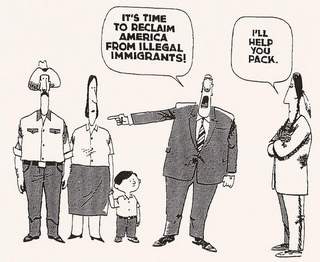


I decided to go with option C because I was too tired and too new to the city to attempt a deep intellectual conversation about American history while also trying to figure out which stop to get off at, in which direction to walk to the convention center, admire the gorgeous mountains, am I going to arrive late to the first session of the day, OMG the mountains are so pretty!!,  consider where to find an inexpensive dinner that night, oh wait did I miss the stop? no its the next one, wait what were we talking about?

I can sometimes be very non-confrontational and downright shy in new environments. Add to that the fact that once I arrived at the convention center I found myself in the minority at such an extreme that I had moments of feeling like A) the mouthpiece for all that is Black and B) a strange oddity to be stared at. The next day I was forced to come out of my shell anyway. There was too much to say and too much to do, to keep quiet. Not to mention there is no hiding when you are highly visible.


Stay tuned for Part 2: Genealogy, Technology & Networking


Mathison, Courtney-Jane. Civil or Hostile?: American Nativism and the Interactions between Migrants in Appalachia, 1865‐1915. http://cas.uwo.ca/documents/mrps/MRP%20CMathisonpdf.pdf  

Monday, April 29, 2013

Love Across Battle Lines Digital Story Outlines

Exhausted after 4 hours of sleep, stress dreams, a long day of school and projects; I decided to get back to work on my LABL digital story before an early bedtime. So much for getting in bed early. It is after 1:30 am but I finally finished my storyboard. Hoping to use these two maps plus the storyboard to animate last months blog post. I am starting to wonder if the Zeega platform can handle it. I suppose we will see. It's due next Sunday night. Wish me luck.


Tuesday, April 9, 2013

Love Across the Battle Lines or Can You Love the Man Who Owns You?: An old family story finds new truths and questions in the archive

A few weeks ago I found out that an old story my mother had been telling me since I was a little girl was actually true!


The Story as told to my mother Rachel Strickland Cook by her Aunt Sugar

We are descended from an enslaved woman and her master's son. According to the story, the son fell in love with one of his family's slaves and refused to marry any one else. This was a disgrace to the family but they could not convince him to change his mind. So they built a little house for the couple to live in on the far edge of the family's property. In that home the couple had about 10 kids. Then the man got sick and died. His sisters came to the home and removed his body and refused to allow his wife and children to attend the funeral. The woman and her many children were then forced to leave their home and struggle on their own. Then she eventually married a black man who could help provide for her children. The children all took the second husband's name, so now it is impossible to find out who their original father was. 

http://www.ecology.uga.edu/cmsAdmin/uploads/103_0400_copy.jpg
Johnny Columbus
Christian Hall -My
great grandfather


My mother and her elderly cousin thought this was the story of my great grandfather Johnny "Fox" Columbus Christian Hall's parents John Hall and Martha (her surname was unknown by my mother and I until only recently). Fox supposedly looked white enough to pass, so everyone assumed that his father was white (see photo). But the story did not match up with the documentation and the birth dates. I had come to believe that I might never find the answer to the puzzle until a few weeks ago when a leaf popped up over Martha's profile on Ancestry.com and revealed her surname, Fortson. An hour later I had found the interracial couple from the story and realized that the end of the story still did not make sense even though the beginning fit perfectly. A new genealogical quest began.


The Story as told by the documents found on Ancestry.com

In the 1860 Elbert County Slave Schedule section of the US Federal Census, a 27 year old white man named William E Fortson is listed with his two slaves, a 20 year old woman and a one year old boy. What the census does not say is that the unnamed woman is his common law wife Mertis Thomas and their oldest son William Jr. The 1860 Federal Census, which only lists free Americans, says that he lives with a 56 year old white woman named Sarah L Henry. Sarah had quite a bit of money and was a lot older (he is only 27 at the time). The documentation does not explain their relationship, but by 1870 she has disappeared.


1860 Slave Schedule. Elizabeth Ham at the top is
William's mother and Delancy at the bottom is his brother. 

The only known photo of Mertis Thomas


On January 19th, 1861 Georgia, the "Empire State of the South," secedes from the Union. 


On January 21, 1861, the ordinance of secession was publicly signed in a ceremony by
At the time of secession, Georgia had more slaves and slave holders
than any other state in the south (http://www.georgiaencyclopedia.org).

On July 15th 1861, William Fortson and his 20 year old brother Elijah enlist in Company I, Georgia 15th Infantry Regiment of the Confederate army. Their three brothers eventually joined them in the war effort but in other companies. John B enlisted February 28, 1862 at 18 years old. Henry Allen age 16, enlisted on March 4, 1862. Delancy age 25 enlisted on May 14,1862.


John B Fortson as an old man - He was the 3rd son born to the Nancy Ham
and Richard Fortson. He was also the thrid to enlist in the military.
Still searching for photos of William.


Example of how the Fortson brothers may have dressed in their Confederate uniforms. 
William like the man on the right was a Sergeant by the end of the war.
(Captain Charles A. and Sergeant John M. Hawkins, Company E, 38th Regiment,

Georgia Volunteer Infantry 1861–62)

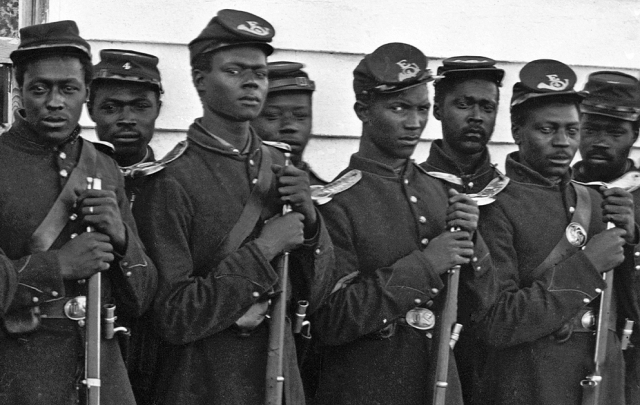
The 15th fights in the battle of Gettysburg July 7th -5th 1863. Unless he was on leave or injured, William would have fought in and survived this historic battle which cost 51,000 lives. Forty percent of his regiment was lost in the battle. He was eventually promoted to 3rd Sargent by May of 1864 then mustered out on April 9th, of 1865 at Appomattox Court House, Virginia. That means he was close by when Robert E. Lee surrendered to General Grant. I have not found any records that show whether William Fortson fought in the battle that led up to the surrender, but it is likely that he did. If so, he may have come up against one of a few colored regiments who fought near Appomattox Court House the morning of the surrender. He would have at least heard that colored troops were nearby. I wonder what William Fortson, father to four little brown skinned boys, would have thought of all these free brown skinned men in blue Union uniforms. If his sons had been old enough would he have allowed them to fight? Which side would they have fought for? Would William still have fought for the Confederacy if his sons had been old enough to question his decision? How would he have explained his choice to them?


"Detail of the men in Company E, 4th U.S. Colored Infantry. 
Original image at Library of Congress" Interpretive Challenges blog.
One of the only known diaries written by a US Colored Troops soldier during
the Civil War. His name was Christian Fleetwood and he was part of
the 4th South Carolina colored regiment. It can be read in its entirety on the
Library of Congress website. *The good stuff starts on page 18.  Thanks to http://interpretivechallenges.wordpress.com/ for the links.

William Fortson obviously returned home a few times during the Civil War. We know this because two of his sons were born between 1862 and the end of 1865. It is hard to determine when Mertis and her children were emancipated. Freedom came to Georgia slaves at different times depending on their location. Some were finding freedom as Bill was stepping into his new grey uniform for the very first time. Many freed themselves by the thousands during the war. Some fell in line with Sherman's army as it marched toward Atlanta, or took off in the confusion and found their way out west. A few wouldn't discover their new status until up to a year after the war had ended. 

William and Mertis continued to live together after the war, appearing in census after census, though both are listed as single every time. I wonder what he told her about his service. He fought for the losing side and at some point around 1865 he came home for good after four long years of war. What did he believe he had fought for? Had that changed by the time he returned home? How did she feel about her relationship with a Confederate soldier? Did it afford her any privileges or open her to further scorn from members of the black community? She and her children were William's only slaves. Their property sat between William's mother's land, which included 12 slaves in 1860, and his brother Delancy's which included only one enslaved 8 year old girl. I wonder if being a Confederate soldier's kept woman was isolating. I will need to do a lot more research and questioning since I am having a difficult time not seeing this story from a 21st century northern born black feminist perspective.


1870 US Census of Elbert, Georgia


1880 US Census of Elbert County, Georgia

By 1900 Mertis has died and the single William is living alone. Next door are two mulatto women (one widowed and the other single) living with a little girl. The women are named Simmy Fortson, a 23 year old teacher, and Fannie a 19 year old housekeeper. They are two of William and Mertis' youngest children. 

In 1910 William is living with daughter Simmie, her husband James Anderson, her daughter Bessie L Hill and her adopted son Henry Thornton. William eventually dies in his 80's. I am unsure if Simmy and her family are living on their father's family land at the time or not. If so they could have been forced to move by William's younger sisters. Also, being that he died in 1919 it is reasonable to believe that his white sisters were too embarrassed by their brother's black family to allow his many colored children and grandchildren to attend his funeral. Without a place to live and a young child to worry about, perhaps Simmy is the woman in the story who must suddenly remarry and change her name. I am still looking for more information about Simmie and William's final resting place.


John B. and Laura Fortson: Were they lovers, cousins or both?
The story of another Confederate veteran and his black families

William's brother John B also had a black partner. Her name was Laura Fortson and she was the only daughter of William and John B's first cousin John Easton Fortson. I heard from my cousin (known as "Brandy411" on Ancestry.com) that Laura was enslaved to the Fortson's but she may also have been a blood relative. I followed that note tonight and figured out that he was correct. It's a long story that is easier to explain via the hand drawn chart below. 

John Easton Fortson moved into his aunt Nancy Ham Fortson's home before the 1870 census. A little mulatto servant girl arrives with him. At the same time John B Fortson is living in the same district with another black "domestic servant", 18 year old Anna Hunt and young daughters, 3 year old Ella, and 1 year old Lucy. The girls are listed as black instead of mulatto but they could still be his children. Right? Why else would a young man hire a domestic servant with children so small she would spend so much time caring for them she would not be able to care solely for him.


In 1880 we find 19 year old Laura Fortson still listed as a servant in her great aunt's home. Curiously above her name we find John B Fortson, suddenly an unmarried Confederate veteran, living at home with his parents and younger sister at age 37. Anna, Lucy and Ella Hunt have disappeared from the records. I simply couldn't find mention of them anywhere. There of course is no 1890 census (stupid fire!!). So we skip to 1900 where Laura is the widowed head of a family of six daughters. Can we assume they are John B's children? Several Ancestry.com family trees have connected them and list him as the father of Laura's children. Unfortunately, I cannot figure out who first made that connection. At first I thought my online cousins were making the correct assumption, then I noticed that she is listed as a widow. Later, I found John B alive and living not too far away with another black family. This time he is listed as the head of the household. He appears to be living with a young black couple (his servants, but who knows what that means when they always seem to be listed that way) in their mid 20's named Daughtery and Jenia Smith and their four children. Someone has gone in and corrected Ancestry.com's records to say that the four children are John B's grandchildren. But how? Could Anna Hunt have given him one more daughter before she disappeared? Were the Hunt girls really his daughters?


The Fortson/Gains/Ham/Gatewood family
Please excuse the poor handwriting. This is how I untangled  the story and documentation.

I continue to have way more questions than answers but that is how genealogy research works. I am happy that most of my initial research questions now have answers. I found the identity of the couple from the story and used their lives to teach myself more about the Civil War and Confederate history in Georgia. 


Oh and since, as of today's research, I can officially apply to both the United Daughters of the Confederacy  and Daughters of the American Revolution, you should look out for future blog posts as I work my way through the application processes. I mean, why not right?

As a proud "grand daughter of Georgia," this is how I celebrate Confederate History Month.